Friday, 9 September 2022

BLOG TOUR - THE GIRL FROM GUERNICA BY KAREN ROBARDS


 Masterfully rendered and vividly capturing one of the most notorious episodes in history, The Girl from Guernica is an unforgettable testament to the bonds of family and the courage of women in wartime.
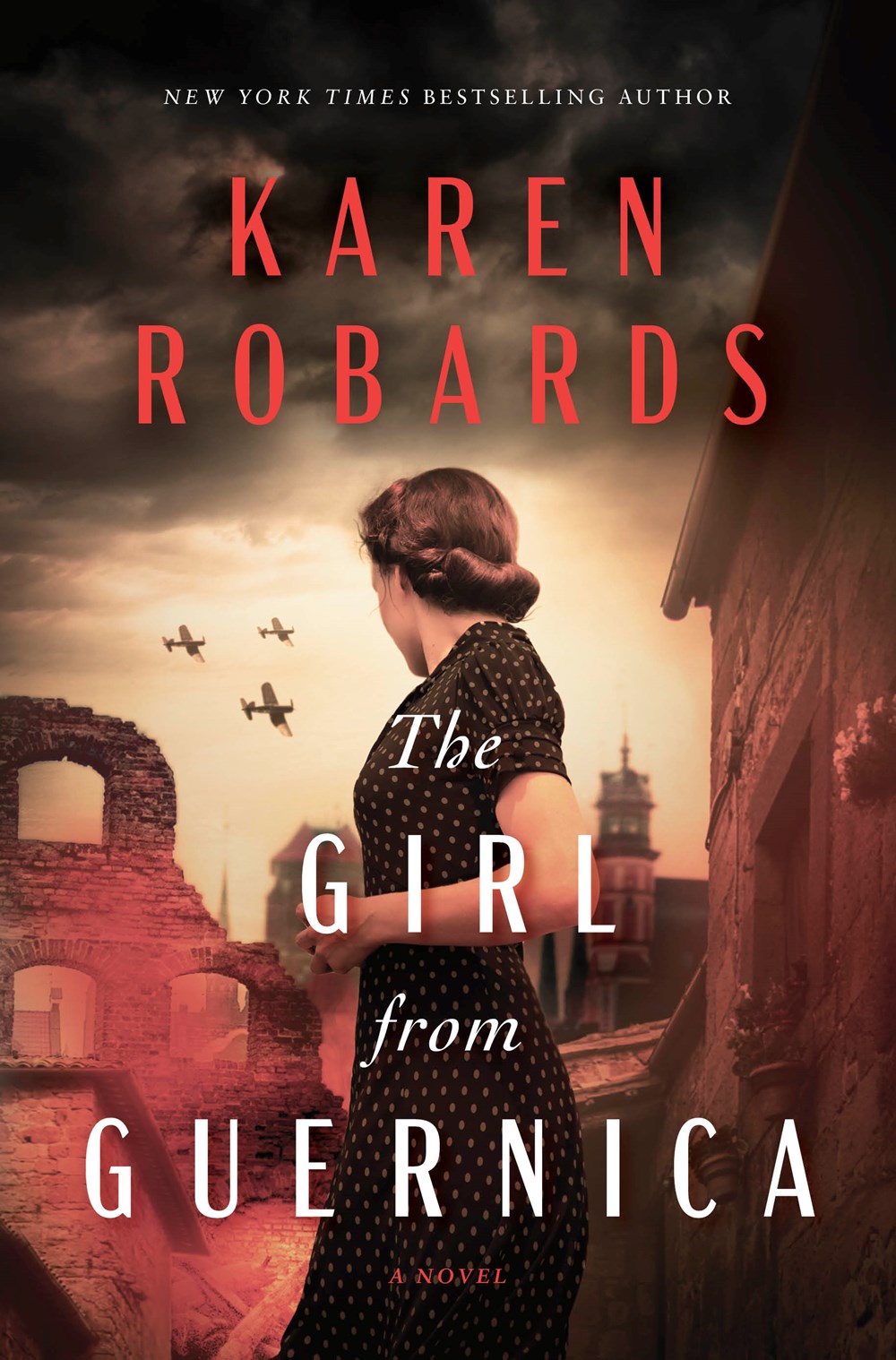
Title: The Girl From Guernica
Author: Karen Robards
Publisher: MIRA
Release Date: 6th September 2022

BLURB supplied by Harlequin Trade Publishing
On an April day in 1937, the sky opens and fire rains down upon the small Spanish town of Guernica. Seventeen-year-old Sibi and her family are caught up in the horror. Griff, an American military attaché, pulls Sibi from the wreckage, and it’s only the first time he saves her life in a span of hours. When Germany claims no involvement in the attack, insisting the Spanish Republic was responsible, Griff guides Sibi to lie to Nazi officials. If she or her sisters reveal that they saw planes bearing swastikas, the gestapo will silence them—by any means necessary.

As war begins to rage across Europe, Sibi joins the underground resistance, secretly exchanging information with Griff. But as the scope of Germany’s ambitions becomes clear, maintaining the facade of a Nazi sympathizer becomes ever more difficult. And as Sibi is drawn deeper into a web of secrets, she must find a way to outwit an enemy that threatens to decimate her family once and for all. 

PURCHASE LINKS
HarperCollins.com
BookShop.org
Barnes & Noble
Amazon
Books-A-Million


EXCERPT

April 25, 1937

To laugh and dance and live in the teeth of whatever tragedies an uncaring fate threw in your path was the Basque way.

The stories Sibi’s mother told, stories handed down through generations of indomitable women, painted those defiant suf­ferers as heroes.

Sibi feared she was not the stuff of which such heroes were made.

She was hungry. Her feet hurt. And she was afraid. Of those things, afraid was the worst by far. She was so tired of being afraid.

A knot in her stomach. A tightness in her throat. A prickle of unease sliding over her skin. Familiar sensations all, which did not make their sudden onset feel any less dreadful. Sixteen-year-old Sibi—Sibil Francesca Helinger—pushed back a way­ward strand of coffee-brown hair that had escaped from the heavy bun coiled at her nape and frowned out into the misty darkness enshrouding the Calle Fernando el Católico. Her

pulse thrummed as she clung to the desperate hope that she was not seeing what she thought she was. Since the fighting had moved close enough so that the residents of this ancient village high in the western Pyrenees could actually hear gun­fire in the surrounding hills, fear had become her all-too-fre­quent visitor. But this—this was different. This was because of something that was happening now, right before her eyes, in the wide, tree-lined street just beyond where she stood watching the regular weekly celebration on the night before market day.

Have we left it too late? The thought made her mouth go dry.

“I want a sweet.” Five-year-old Margrit’s restless movement beside her reclaimed her attention. Gripping the child’s hand tighter, Sibi cast an impatient glance down.

“There’s no money for a sweet.” Or anything else, Sibi could have added, but didn’t.

“But I want one.” Round blue eyes in a cherubic face sur­rounded by gold ringlets stared longingly at the squares of honey and almond turrón being hawked to the crowd by a woman bearing a tray of them. The yeasty aroma of the pas­try made Sibi’s stomach growl. For the last few weeks, she and her mother had been rationing their diminishing resources by skipping the evening meal so that the younger ones could eat.

“Ask Mama to buy you one later.”

Margrit’s warm little fingers—which Sibi kept a secure hold on because, as angelic as the youngest of the four Helinger sisters looked, she wasn’t—twitched in hers. “She won’t. You know she won’t. She’ll say she doesn’t have any money, either.”

That was undoubtedly true. In fact, Sibi had only said it in hopes of placating her little sister until their mother returned. Thinking fast—Margrit had mostly outgrown tantrums, but not entirely—Sibi was just about to come out with an alternate suggestion when thirteen-year-old Luiza jumped in.

“You know we’re poor now, so stop being such a baby.” Cross because she hadn’t been permitted to go to the cinema

with a group of her friends, Luiza spoke sharply. The thick, straight, butterscotch blond hair she’d chopped to chin length herself the night before—”Nobody has long hair anymore!” she’d wailed in the face of their mother’s horror—had already lost its grip on the rag curls she’d forced into it. She looked like she was wearing a thatch of broom straw on her head, but Sibi was far too good a sister, and far too preoccupied at the moment, to point that out.

“I don’t like being poor.” Margrit’s lower lip quivered.

“None of us do.”

“I specially don’t like—”

Luiza cut her off. “You’re whining. You know what Mama said about whining.”

“I am not…”

A match flared in the street. Tuning her sisters out, Sibi fo­cused on what the brief incandescence revealed as it rose to light a cigarette—red tip glowing brightly—before arcing like a tiny shooting star to the ground. Sibi looked beyond the ciga­rette to the dark shape behind it. The dark shapes behind it. She wasn’t mistaken. Soldiers—their soldiers, the loyalist Republi­cans, their uniforms unmistakable—poured into the street from seemingly everywhere. And the numbers were increasing…

Her heartbeat quickened. Does no one else see?

Biting down on her lower lip, she glanced around. The crowd clapped and swayed to the rollicking music of the highly prized town band and ate and danced and played games and— She concluded that no one else did. The village leaders who were present appeared unaware: Father Esteban talked to the woman behind the refreshment table as she ladled out a bowl of spicy fish soup for him; His Honor the mayor played mus, the popular card game, with three friends; the Count of Arana, the town’s most prominent citizen, stood with his arms crossed and a stern gaze fixed on his fifteen-year-old daughter, Teresa,

as she walked away from him with her hand tucked into the arm of… Emilio Aguire.

Sibi’s stomach gave an odd little flutter.

Watching them reminded her of just how much of an out­sider she was here in this quaint small town with its red-roofed white houses and narrow cobbled streets. Emilio was her age, he was the handsomest boy in school and he had been kind to her. She had hoped… But no. To hope for anything where he was concerned was foolishness. She and her mother and sisters were only temporary residents. She worked as a part-time wait­ress and her mother had worked in a dress shop before being fired three weeks ago, when the shop owner’s husband had displayed too much interest in her. And that, of course, had immediately become a topic for much discussion among the town gossips whose gleeful suspicions that the former Marina Diaitz, now Helinger, who had come home with her children but without her husband, was a floozy were thus seemingly confirmed. All those factors combined to put them near the bottom of the social ladder in this place where the wealthy local aristocracy had been comfortably in place for generations, and they, with their German father, would have been outsid­ers, anyway. And Teresa was beautiful and rich and— Well, there it was, foolishness.

She had no time for foolishness.

Glancing at those in her own party—Luiza and Margrit, and their other sister Johanna, all bunched close around her, and their mother, Marina, dancing merrily with the baker Anto­nio Batzar beneath the colored lights strung above the make­shift dance floor in hopes of securing a scarce loaf of tomorrow morning’s fresh bread—Sibi felt her heartbeat quicken.

Intent on their own concerns, they appeared oblivious to anything else. As usual it was up to her, notorious as the fam­ily worrier, to think about what might happen, to catch and make sense of what the rest of them missed.

Tonight, it was that their soldiers, their last line of defense against the surging rebel Nationalists, appeared to be coming together en masse to slink like starving cats past the Sunday night festivities.

These were the same war-weary, battle-scarred troops that had been camped out in the forested peaks surrounding the town since they had fallen back after the savage attack on the neighboring village of Durango that had brought the nine-month-old civil war as close as its ancient churches and ram­bling streets. In the days since, thousands of panicking refugees had flooded the town. The warships of Generalissimo Francisco Franco, commander in chief of the rebel forces, had blockaded the Basque ports. Food had become scarce: along with bread, milk and meat were almost impossible to obtain. People were hungry, frightened. The war that had been safely on the other side of the country had changed direction so fast that the resi­dents of these sleepy villages high above the Bay of Biscay had been caught unprepared. But unprepared or not, in a new and terrifying offensive the newspapers were calling the War of the North, the fighting was now rushing like a wave toward their front door.

The soldiers were all that stood between them and the enemy forces determined to destroy them. And the soldiers were leav­ing.
 
 
ABOUT THE AUTHOR 

Karen Robards is the New York Times, USA TODAY and Publishers Weekly bestselling author of fifty novels and one novella. She is the winner of six Silver Pen awards and numerous other awards. 


Wednesday, 7 September 2022

WISHLIST WEDNESDAY - ANIMAL AUDUR AVA OLAFSDOTTIR


Title: Animal Life
Author: Audur Ava Olafsdottir
Publisher: Grove Atlantic, Grove Press, Black Cat
Genre: General (Adult) Fiction
Release Date: 6th December 2022

BLURB from Goodreads
From winner of the Nordic Council Literature Prize and the Icelandic Literary Prize, Auður Ava Ólafsdóttir, comes a dazzling novel about a family of midwives set in the run-up to Christmas in Iceland

In the days leading up to Christmas, Dómhildur delivers her 1,922nd baby. Beginnings and endings are her family trade; she comes from a long line of midwives on her mother’s side and a long line of undertakers on her father’s. She even lives in the apartment that she inherited from her grandaunt, a midwife with a unique reputation for her unconventional methods.

As a terrible storm races towards Reykjavík, Dómhildur discovers decades worth of letters and manuscripts hidden amongst her grandaunt’s clutter. Fielding calls from her anxious meteorologist sister and visits from her curious new neighbour, Dómhildur escapes into her grandaunt’s archive and discovers strange and beautiful reflections on birth, death, and human nature.

With her singular warmth and humor, in Animal Life Ólafsdóttir gives us a beguiling novel that comes direct from the depths of an Icelandic winter, full of hope for spring.


PURCHASE LINKS
Amazon US (No link yet)


Thursday, 1 September 2022

REVIEW - TAKEN BY MICHELLE PEARSON


Title: Taken
Author: Michelle Pearson
Publisher: Ad Lib Publishing, Mardle Books
Genre: Non-Fiction, Biographies, Memoir, Parenting
Release Date: 1st September 2022

BLURB from Goodreads
In 1972, Michelle Pearson gave up her son for adoption.

As ‘one of those girls’, she was expected to hide her shame with secrecy. No one should ever find out she’d had a child.

But she never forgot the son who was taken from her.

In the years that followed she struggled with PTSD, traumatic memory loss, agoraphobia and anxiety – impacting every area of her life.

This is Michelle’s story of love, loss and hope; of how over 50 years she has managed the consequences of living with her secret, survived the emotional pain, and finally, after being reunited with her son, the journey to rebuild their lives together.

Goodreads Link

PURCHASE LINKS
Amazon US
Amazon UK

REVIEW
The byline heading at the top of the book cover "Stolen Lives" fits perfectly as although Michelle did have a life, and so did her son Tim/John who was taken from her, they did have their opportunity at a life together stolen from them by a group of people and organisations who thought being an unwed mother was the fault of the young girl/woman and that they knew better. Rather than support the girl/woman with her child if that is what the girl/woman wanted they "knew best" and all but a few were railroaded into giving up their precious babies for adoption.

Michelle's story is told in a very matter of fact way, stating facts, timelines, dates etc. I think Michelle tells her story in a very forthright manner, straight to the point. I have read other similar stories of forced adoption and I think this style of telling her story about being forced into putting her precious baby son should not be mistaken as coldness, but as a way to try to reign in the tumultuous emotions she must have had to revisit to write this book.

It's almost as if Michelle has had to separate herself from 'young pregnant Michelle' it was in a different era at times in the books it's as if it happened to a different person too but it's important to remember this isn't a fictional story, this actually happened to Michelle, to real people, real lives were and are still affected.
Utmost respect to Michelle for holding back & accepting her sons decision to keep their reunion a secret from his adoptive parents. It must have been a difficult secret to keep as well as agony emotionally keeping it secret too.

I guess Michelle had a 'happy ending' in that she was reunited with her son and is part of his life, not everyone gets this favourable ending. It could have been so very different for Michelle if Tim/John's adoptive mother had got her way. Also can it truly be called a 'happy' ending after all the heartbreak Michelle went through, she was seen as the 'bad' girl from the moment it was revealed she was pregnant.....it takes two to make a baby! Yet Tim was seen as being the 'responsible one.' The 'loose morals' label was definitely hung around Michelle's neck and made heavier to bear both during her stay at the mother and baby home and afterwards in her adult life. I found myself shaking my head, gritting and grinding my teeth in anger at how Michelle was made to feel by those around her. It's so easy to dismiss it all as being down to the era she was living in, her parents religion etc. I dread to think how many women are out their grieving for lost children. The ones too scared to try to make contact, or where there is not enough information or even where the adopted child refuses contact.

I was equally shocked and horrified that this actually happened so recently, I guess it happening in 1972, when I myself was born in 1971 made me feel like it wasn't that long ago. This also led me to the question when did this "forced adoption" actually stop. Sadly I don't think lessons have been fully learnt as those in power with authority seem to always think that they 'know best'. That there is a 'one size fits all' solution to every/any problem or issue that arises.

Summing up, though it feels odd and wrong to use the word 'enjoy' in connection to such a heart rending book but I did enjoy reading it, I found it thought provoking and informative. It made me think about what sort of pressure is put on young pregnant girls these days, or are they given the whole picture as there seems to be much more help available now. I struggled a little at the beginning, not getting on well with the style in which Michelle's story was being delivered. However, I was pulled into the book more and more as time went on, was in tears in quite a few places within the book and wanted to reach through the book and hug both 'young Michelle' and older Michelle on many occasions.


Monday, 29 August 2022

BLOG TOUR - THE THREAD COLLECTORS BY SHAUNNA J. EDWARDS & ALYSON RICHMAN


Title: Thread Collectors
Authors: Shauna J. Edwards & Alyson Richman
Publisher: Graydon House
Release Date: 30th August 2022

BLURB supplied by Harlequin Trade Publishing
1863: In a small Creole cottage in New Orleans, an ingenious young Black woman named Stella embroiders intricate maps on repurposed cloth to help enslaved men flee and join the Union Army. Bound to a man who would kill her if he knew of her clandestine activities, Stella has to hide not only her efforts but her love for William, a Black soldier and a brilliant musician.

Meanwhile, in New York City, a Jewish woman stitches a quilt for her husband, who is stationed in Louisiana with the Union Army. Between abolitionist meetings, Lily rolls bandages and crafts quilts with her sewing circle for other soldiers, too, hoping for their safe return home. But when months go by without word from her husband, Lily resolves to make the perilous journey South to search for him.

As these two women risk everything for love and freedom during the brutal Civil War, their paths converge in New Orleans, where an unexpected encounter leads them to discover that even the most delicate threads have the capacity to save us. Loosely inspired by the authors' family histories, this stunning novel will stay with readers for a long time.

PURCHASE LINKS
HarperCollins.com
BookShop.org
Barnes & Noble
Amazon
Books-A-Million
McNally Jackson

EXCERPT


New Orleans, Louisiana March 1863

She opens the door to the Creole cottage just wide enough to ensure it is truly him. Outside, the pale moon is high in the sky, illuminating only half of William’s face. Stella reaches for his sleeve and pulls him inside.

He is dressed to run. He wears his good clothes, but has chosen his attire thoughtfully, ensuring the colors will cam­ouflage in the wilderness that immediately surrounds the city. In his hand, he clasps a brown canvas case. They have only spoken in whispers during their clandestine meetings about his desire to fight. To f lee. The city of New Orleans tee­ters on the precipice of chaos, barely contained by the Union forces occupying the streets. Homes abandoned. Businesses boarded up. Stella’s master comes back from the front every six weeks, each time seeming more battered, bitter and rest­less than the last.

William sets down his bag and draws Stella close into his chest, his heartbeat accelerating. He lifts a single, slim finger, slowly tracing the contours of her face, trying to memorize her one last time.

“You stay here, no matter what…” he murmurs into her ear. “You must keep safe. And for a woman like you, better to hide and stay unseen than venture out there.”

In the shadows, he sees her eyes shimmer. But she balances the tears from falling, an art she had been taught long ago—when she learned that survival, not happiness, was the real prize.

Stella slips momentarily from William’s arms. She tiptoes to­ward a small wooden chest. From the top drawer, she retrieves a delicate handkerchief with a single violet embroidered in its center. With materials in the city now so scarce, she has had to use the dark blue thread from her skirt’s hem to stitch the tiny flower on a swatch of white cotton cut from her petticoat.

“So you know you’re never alone out there,” she says as she closes William’s fingers around the kerchief.

He has brought something for her, too. A small speckled cowrie shell that he slips from a worn indigo-colored pouch. The shell and its cotton purse are his two most sacred pos­sessions in the world. He puts the pouch, now empty, back into his pocket.

“I’ll be coming back for that, Stella.” William smiles as he looks down at the talisman in his beloved’s hand. “And for you, too… Everything will be different soon.”

She nods, takes the shell and feels its smooth lip against her palm. There was a time such cowries were used as a form of currency for their people, shells threaded on pieces of string exchanged for precious goods. Now this shell is both worth­less and priceless as it’s exchanged for safekeeping between the lovers.

There is no clock in her small home. William, too, wears

no watch. Yet both of them know they have already tarried too long. He must set out before there is even a trace of sun­light and, even then, his journey will be fraught with danger.

“Go, William,” she says, pushing him out the door. Her heart breaks, knowing the only protection she can offer him is a simple handkerchief. Her love stitched into it by her hand.

He leaves as stealthily as he arrived, a whisper in the night. Stella falls back into the shadows of her cottage. She treads si­lently toward her bedroom, hoping to wrap herself tightly in the folds of the quilt that brings her so much comfort.

“You alright?” A soft sound emerges in the dark.

“Ammanee?” Stella’s voice breaks as she says the woman’s name.

“Yes, I’m here.” Ammanee enters the room, her face bright­ened by a small wax candle in her grip.

In the golden light, she sits down on the bed and reaches for Stella’s hand still clutching the tiny shell, which leaves a deep imprint in her palm.

“Willie strong,” Ammanee says over and over again. “He gon’ make it. I know.”

Stella doesn’t answer. A flicker of pain stabs her from the inside, and she finally allows her tears to run.

ABOUT THE AUTHORS

SHAUNNA J. EDWARDS has a BA in literature from Harvard College and a JD from NYU School of Law. A former corporate lawyer, she now works in diversity, equity and inclusion. She is a native Louisianian, raised in New Orleans, and currently lives in Harlem with her husband. The Thread Collectors is her first novel. Find her on Instagram, @shaunnajedwards.

AUTHOR LINKS 
Facebook: Author Shaunna Edwards
Instagram: @shaunnajedwards
Goodreads
  

ALYSON RICHMAN is the USA Today and #1 international bestselling author of several historical novels, including The Velvet Hours, The Garden of Letters, and The Lost Wife, which is currently in development for a major motion picture. Alyson graduated from Wellesley College with a degree in art history and Japanese studies. She is an accomplished painter and her novels combine her deep love of art, historical research, and travel. Alyson's novels have been published in twenty-five languages and have reached bestseller lists both in the United States and abroad. She lives on Long Island with her husband and two children, where she is currently at work on her next novel. Find her on Instagram, @alysonrichman.


AUTHOR LINKS
Alyson Richman - Author Website
Twitter: @alysonrichman
Facebook: Author Alyson Richman
Instagram: @AlysonRichman
Goodreads